Translate

A következő címkéjű bejegyzések mutatása: Mapuche. Összes bejegyzés megjelenítése

2016. április 26., kedd

THE RED-HAIR RACE IN AMERICA


From the genetic evidence, it appears that trans Atlantic crossings have been going on for a long time - the reddish/brown haired, green eyed Auracanians of coastal Chile and Peru not only have some 4-6,000 year old Indonesian genes in them (James L Guthrie), but they also have 12-18,000 year old Caucasian genes forming the basal layer of their complex genetic history. Aztec history confirms that Native Americans in ancient times were Caucasian. This period in history was called; "The Age of the Blonde Haired Bearded Giants". It was these people who made up the majority of Eurasian and American populations at the time when the kingdom of Atlantis existed - the mother of many European and American cultures. This period of human history ended with a terrible natural catastrophe. Historical records indicate that an earthquake destroyed an island in the Mid Atlantic(Atlantis) and an associated tsunami swept through the Caribbean (Anasazi legend) and down the Mediterranean(destroying the Greek army) 11,500 years ago and ended this "Golden Age".

After the Golden Age - according to Aztec/Toltec history, 7,590 BC was the beginning of “Age of the Red Haired People." They enslaved the remnant populations of the blonde haired giants, using them to build their megalithic monuments. Cro Magnon man according to the Mayan 'Popul Voh' was very trusting and gullible. He was not familiar with the lies and trickery of this new breed of humans and was easily manipulated. The Mayan 'Popul Voh' is packed full terrible deeds done to these peacable giants.

In Europe, the children's story of Jack and the bean stalk quite likely goes back to this time after Atlantis where the surviving giants of the 'Golden Age' possessed the knowledge of gold production, but the new breed of humans (the Red Heads) represented by Jack and his mother did not want giants
around anymore, nor did they merely just want the giants stash of golden eggs, they wanted the technology of gold production, represented by the goose that laid the golden eggs, Jack succeeded in obtaining the 'technology of Gold production and then killed the giant. It is also interesting to note that giants in many fairy stories are depicted as being naive or easily tricked.

According to Aztec/Toltec legend, 5,500 years ago, began "The age of the Black Haired People". Geneticists have identified that the East Asian migration into America began ~6,000 years ago. 500 years before American legends say it happened. This is an acceptable time period for the founder populations to gather momentum. It is interesting to note that Sumerian legends also state that the Age of the Black haired people in the Mediterranean began about 5,500 years ago. Obviously there was a catastrophe on a global scale and random chance favoured the Black Haired people. This is most likely the beginning of Austronesians crossing the Pacific via the Kuroshio current.

Carthaginian ships
Further proof that Native Americans prior to this time were essentially Caucasian is the 7-9000 year old red haired mummies that have been found in Nevada. Kennewick man, a Native American was also Caucasian, but not form Europe.

The common origin of both European and American culture from the ancient civilization of Atlantis makes total sense when we start looking at the cultural similarities. Many books have been written about the similarities between Mayan and Egyptian science, especially in the realms of Astronomy, calender and mathematics. Mayans even share the same war god as many European tribes; Votan in Mayan legends and Woden in Viking legends, (Votan and Woden is deemed to be linguistically the same).

One may ask; why is there not a greater degree of caucasian racial types evident in America today?

This can easily be explained through the interaction between dominant and recessive genes.

Once Asians began interbreeding with the Native Americans, the recessive genes of red hair and blue eyes quickly dissappeared. Despite this, there is still some evidence of this earlier racial type in some Native Americans. The Araucano appear to be one of the most significant remnant populations (300,000 in Chile) of this previous age of Red Heads in America . Elsewhere, native Americans have a lesser degree of this Caucasian heritage, although many Native North Americans are tall with long narrow skulls and wiry features - characteristic features of these early Caucasians. Most native Americans are blood group O (European) and not B(Asian). The Araucano are also 20% Rhesus negative, putting them up there with the Irish and the Basques as being the most closely related to the original Europeans. (Cro Magnon man was blood group O- and Rhesus negative). Not only is Rhesus negative a recessive gene, but blonde hair, red hair and blue eyes are all recessive genes and any interbreeding with dominant brown eyed/black haired individuals of blood group B, will lead to the dissappearance of these visual characteristics. Not only this, but due to isolation of these original Caucasians, they became vulnerable to disease brought in from outside America. This process was observed in the Pacific by the early explorers. First accounts of Tahiti indicated that over ten percent of the Population was Caucasian, but when another ship arrived 8 months later, most of these Native Caucasians had already succumbed to disease brought by the earlier European ship. Despite this, Polynesians placed these people in high esteem and they were often found in positions of power within Polynesian society. The practice of the bride withdrawing to a darkened hut or cave for weeks before her wedding day was to show she had some of this ancient royal blood and exemplifies the position these white people held in society. Ancient Caucasian genes have been lost in the Pacific and America, not through war or genocide, but through natural processes where the genetically stronger individuals become the dominant population.

Thor Heyerdahls research uncovered a burial chamber that contained what is now known as 'The Paracas Mummies'. To his surprise, they had red and blonde wavy hair, with long skulls. These people conducted extensive ocean voyages off South and Central America on Balsa Rafts between 300 BC and 400 AD. Their culture was undoubtedly South American in every way, but they were also a type of Caucasian. The Araucano would have been related to this group.There is also a high probability that the red haired long ears of Easter Island, represented by the Moai statues, are also from a similar gene pool as the Araucanians who according to James L. Guthrie, possess both Caucasian and Indonesian genes. The practice of elongating ears was common practice by mariners in the Maldives and Borneo and could have been a custom brought to America and the Pacific by people sporting Indonesian genes. More research on this early Austronesian long ear phenomenon is sure to uncover some interesting facts.


 Cultura Chachapoya
 Paracas mummy

 Cultura Chachapoya

 Cro-Magnon people's


References:


http://www.burlingtonnews.net/redhairedmummiescanaryislands.html
http://despiertaalfuturo.blogspot.com.br/2013/11/el-reino-perdido-de-los-chachapoyas-en.html
https://www.blogdeviajes.com.ar/2007/03/26/cronicas-de-chachapoyas-6-aya-chaqui/
http://atlantisforschung.de/index.php?title=Die_Chachapoya_und_die_Kelten
http://survive2012.com/american-pyramids/
http://www.amren.com/news/2013/09/how-did-blonde-whites-arrive-in-peru-before-columbus/
https://hu.pinterest.com/pin/481040803929346874/

2015. december 22., kedd

ŐSI SZAVAINK: VILÁGÍT


Ősi szavaink: VILÁGÍT


A világít az egyik olyan  ősi szó, amelynek az eredete több mint bizonyos, hogy visszanyúlik az első modern emberek megjelenésének a korába Európában és Ázsiában.
A „vil/vir” szótő továbbképzett formái: vil-ág , vil-ágos , vil-ág-ít , vil-ág-os-ság vagy vér , ver-es…

A vil/vir vagy bil/bir/pir  rokon ősi gyökből egy sor fénnyel kapcsolatos szó alakult ki az eltelt idők folyamán.
pír , pir-kad., pir-kad-at , pir-os , pir-it…..

Ez a szó avagy hasonló kifejezési formája megtalálható az Indo.-Európai és a Finnugor nyelvekben , de messze túl nyúlik az Európai kontinensen. Az őseink magukkal vitték az Amerikai kontinensre.  Amerikában a Cendes-Óceán parti vidékén a Makro-Penutian ( Californian Penutian, Mayan, Mochican, Uru-Chipayan és Mapuchean ) nyelvi egységhez tartozó népek nyelveiben ma is megtalálható.
A szó egyfelől bizonyítja a  Makro-Penutian egység fennállását  és egyben a Magyar nyelv ősiségét, rokonságát ezen nyelvekkel..


VILÁGOS  „ Light / Bright „

- Hungarian :  

vil-ág , vil-ágos , vil-ág-ít , vil-ág-os-ság , 

- Sumer :  

bir / piriŋ „ bright „ , bar / paar „ white „ , bil / bil2 / bil3 „ to burn „ >

-  Proto-Indoeuropean : 

bherəg „ light „ (v>bh) >

- Finn-Ugrian:

 Zürjén : vir „ blood „ (l>r) , Udmurt : vir „ blood „ (l>r) , Osztják : wer/wir „ blood „ (v>w , l>r) , Cheremisz : vür „ blood „ (r>l)
b=v , r=l

Californian Penutian:

Plains M. : wel.i „ bright „ / wilep-y „ to shine „ ,
S.S.M. : we-la-nt „ light „ / wela’-t-st.l „ to shine „ , Mutsun : wiya „ light „ ,
Wintu : walu.qa „ to lighten „ , weloq „ red day „ ,
w>b>p = v , r>y  = l  , q = g

Mayan:

Proto-Mayan: *b'o7y
Itza Maya: b'o7oy  „shadow (que dan los a*rboles) „
Itza Maya: b'o7oy „ shadow (de persona o animal) „
Mopan: bo7oy „ shadow  (que dan los a*rboles) „
Mopan: bo7oy „ shadow (de persona o animal) „
b=v , y=l

Uru-Chipayan:

Uru : wali  sii-chay ( Muysken ) „light „
w = v

Mapuchean :

Mapuche:
pelo / pelontu „ light „ / wilüf külen „ shine „
 p=v


2015. december 19., szombat

THE MOCHICA (MUCHIK, CHIMU, YUNGA, YUNCA) LANGUAGE


THE MOCHICA (MUCHIK, CHIMU, YUNGA, YUNCA) LANGUAGE


The Mochica society lives at the coats of North Peru before Christ.
They have made important civilizations. From the beginning of the time to AC 600 the capital of the Mochica culture was the city of Moche. Later the cenre became the city of Pampa Grande near the Lambeyegue River . (Lambeyegue or Sican culture). Later there was the Chimu culture from AC 900 to AC 1470. The population of the Chimu Empire’s capital was about 100.000 people.In 1664 this language was spoken by only 40,000 people because of the conquistadors.The Mochica language was the most important language in South America.It was firstly documented in 1607 (Ore).
The first important work was connected to the name of Fernando de la Carrera Daza in 1664.
His work is ’Yunga de gramática de la lengua’.
As a spoken language it extinced in 1950.
There were some attemption to rebirth the language . The he origin of the language and the society is ambigious. It was classified to the Chicha-Páez inguistic unit of the Páez language famailies – uncorrectly.
A ccording to Adelaar and Muysken in 2004 the Mochica language is an isolation.
Louisa Stark: the construction of the languages of the Mochica, Uru-Chipaya and the Mapuche family languages are similar to the Mayan languages. The ancestors of the Mochica, Uru-Chipayan and the Mapuche people moved to the coast of Peru.There are many features of the Mochica language which are similar to the Mayan language. It proves the common origin of them.The Mochica language is agglutinative.Construction of syllables: V, CV, VC or CVC.
Schmidt 1926: Mochica-Yunga-Tallan
The classification of the Mochica (Chimuan) languages :

    NORTHERN GROUP (CANARI - PURUHA)


+ 1. Canari
+ 2. Puruhua

    CENTRAL GROUP (TALLAN- SECHURA)


+3. Colan
+4. Catacao
+5. Sechura
+6. Olmos

C. MERIDIONAL GROUP

1. Mochica
2. Quingnam


THE URU - CHIPAYAN (CHIPAYAN, PUQUINA) LANGUAGES

THE URU - CHIPAYAN (CHIPAYAN, PUQUINA) LANGUAGES


The word ’Uru’ is originally Kechua, it means ’derogatory’, ’worm’.
Uru people called hem selves ’people of the water’. Their originally name is Cotsuny. According to them their ancestors are beings of water, not people.The language family is located in South Peru, the coast of North Chile, Lake Titicaca, Desaguadero River in Bolivia and the Lake Poopo.Uru people considerate them selves as the oldest type of humans.The Puquina language was a transmitter language (lingua Geral) in the 16 century in Peru.The Inca emperials spoke this language as well.The Proto_Puquina language was spoken in the Chiripa-Pucara culture from BC 200 to AC550. The Puquina language was spoken in the Tihuanaco culture from AC 500 to AC 1200. Itexcinted in the 18th century.The grammar origin of the Kallahuaya language is the Kechua language and some words originated from the Puguina language.
The Uru and the Chipaya languages have disappeared after the conquestadors because of the Aymara – Kechua and Spanish languages.Today Chipaya language is spoken by 2,000 people in Bolivia. The Uru language is almost excinted.
The Uru-Chpiaya languages were written down between 1900 and 1950.The agglutinative languages have a strong influence of Kechua, Aymara and Spanish.Earlier it was classified as apart of the Macro-Arawak language. Today is is tend to be alinguistic isolation and as a relative of the Mochica language.More linguistics think that there is a relationship between the Uru-Chipayan and the Middle American Macro-Mayan languages.Louisa Stark 1972: Mayan-ChipayanWheeler 1972: Mayan-Chipayan-AraucanChampbell: 1993: Mayan-ChipayanAccording to Benjamin Whorf the Mochica, Uru-Chipayan amd the Mapuche languages arein the same family and they are connected to the Middle American and the Californian Penutian languages.
 The form of the syllable in the Uru-Chipayan language can be CVCC or CCVC, but the most common forms are CVC and CV.

The classifiaction of the Uru-Chipayan languages:

URU-CHIPAYAN LANGUAGES

1. Uru (Kotsuny, Uruquilla) Bol.- Peru+
a.     Uchumataqu Bol.

+ b. Uru Chimu) Peruc.
c. Uru (Kotsuny) Bol
.d. Iru - ito Bol.
e. Uru - Murato Bol.
+ f. Urusmayo Arg.
+ g. Lipisa Bol.
2. Chipaya Bol.

 CHANGO (URU - ATACAMA, CHANGO - ATACAMA) SUB –GROUP :

+3. Chango Chile
+ 4. Camanchaca Chile
+ 5. Pro - Anche Chile
+ 6. Uru de la Costa Chile

PUQUINA SUB – GROUP :

+ 7. Puquina (Pukina) Peru - Bol.
8. Callahuaya Bol.- Peru


Chipaya women, Bolívia
Uros, Titicaca lake

2015. december 15., kedd

URU – CHIPAJA ( CHIPAYAN , PUKINA ) NYELVEK


URU – CHIPAJA ( CHIPAYAN , PUKINA ) NYELVEK


Uru, Uros, Uruquillas . Egyéb nevek Kjotsuñi / Kotsuña.
Az „ Urus „ szó Kasztiliai nyelven „ a hajnal „ , más  ismert szinonimái a Jas-Shoni ( „ A víz emberei „ ) és Kot'suña ( „ a Tó emberei „ ) .
 Ősi hagyományaik szerint az őseik mitológiai vízi lények voltak  nem pedig emberek.
Az első dokumentált tizenhatodik századi spanyol források szerint az úgynevezett Urus vagy Uruquillas emberek a mai Peru és Bolíviai nagy tavak körül éltek a Titicaca - tó,  
Poopó - tó, és Coipasa - tó, és a tavakat összekötő  folyók mellett, valamint
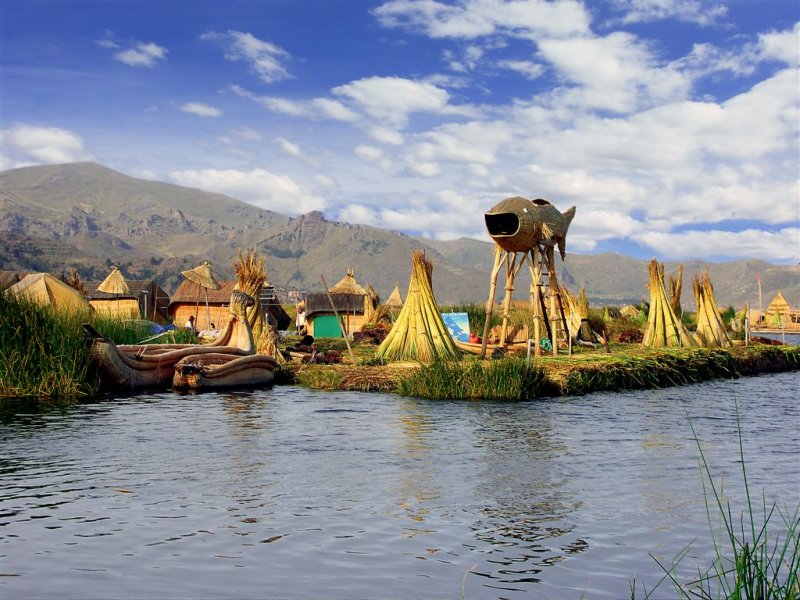
úgynevezett Titicaca - tavi úszó szigeteken. Legdélibb csoportjuk észak - Argentínában élt.
A világ legősibb emberi típusának tartják magukat.
Az Uruk megélhetése alapult a halászaton  és madár  vadászaton.
Az inka és később a spanyol gyarmati betelepítések miatt az Uruk sokat veszítettek ősi életmódjukból  és házasodtak a környező Ajmara népességgel.
 A huszadik század elejére több kis csoportokra oszlottak .
A legismertebb csoportok az Urus , akik a  Titicaca - tó "úszó szigetein" ma főként a turizmusból élnek.
Az Urus Irohitok a Titicaca - tó déli részén
A Muratok a Poopó - tó  partján és a szigetein.
Az Uru - Chipaja nyelveket mára erősen befolyásolták és háttérbe szorították az Ajmara és a Kecsua nyelvek, valamint a Spanyol nyelv.
Azonban a szóbeli hagyományok , a ruházat  és bizonyos elemei az Uru anyagi kultúrának a mai időkig fennmaradt .


- Uru  Ch'imu nyelv

Az Uru  Ch'imu egy kihalt Uru nyelv. Az etnikai csoport a nyugat Titicaca - tó Puno  Bay területén nád szigeteken él.
Ch'imu Uru népet 1929-ben Lehmann fedezte fel, akinek a jegyzetei a Berlini Ibero-Amerikai Intézet könyvtárában van.
Torero (1992) azt állítja, hogy az Uru Ch'imu ( Puno ) a leginkább eltérő a három Uru-Chipaya nyelven.

 -Iru-Itu (Uchumataqu) nyelv
 

Az Uru nyelv, pontosabban az úgynevezett Iru-Itu ( Uchumataqu ) az Uru nyelvcsalád egyetlen túlélő nyelve. A Bolíviai Ingavi tartomány, La Paz  megyében,  a Titicaca - tó közelében, a Desaguadero folyó  mellett élnek,
Az 1994-es népszámlálás azt mutatja, hogy meglepő módon 59 Iru Itu állította, hogy ismeri a nyelvet, amelyet a valóságban csak néhány idős ember beszél ( Crevels 2007 ). 
 2004-ben 2  anyanyelvi szinten beszélő élt a 140 fős etnikai csoportból . A többi áttért az Ajmara és a Spanyol nyelv használatára. A nyelv elég közel áll a Chipaja nyelvhez.

- Chipaja ( Chipaj Taqo )

 A Chipaja ( Chipaj Taqo ) nyelvet beszélők a Bolíviai Altiplano egy 3670 méteres tengerszint feletti magasságú területen élnek, hol az extrém nappali-éjszakai hőmérséklet-ingadozásokat, a sós talaj és az áradások az esős évszakban  (novembertől - márciusig) korlátozza a  hatékony mezőgazdaságot és az állattenyésztést.
Ezért ma sok Chipaja vándorolt dolgozni a szomszédos Chilébe vagy keleti Bolíviába.
A Chipaja közösségek fontos megélhetése a halászat és a madár-vadászat a Lauca folyó melletti területeken.
A név "Chipaya" talán ered az  Ajmara ch'ipaña  "lekötni" szóból utalva hogy  hálószerűen lekötik a házaikon a tetőt.
Az 1992-es és 2001-es népszámlálás adatai azt mutatják, hogy a Chipaja nyelvet nem csak az idősek beszélik , hanem megtanulta a fiatalabb generáció.
 A népszámlálás adatai szerint 1600 anyanyelvi szinten beszélő Chipaja volt , etnikumi szinten 2000 fő.
A Spanyol nyelvet  viszonylag fiatal korban, míg az Ajmara nyelvet csak nagy korban sajátítják el . Néhány kisebb  Chipaja közösség tagjai Kecsua nyelven beszél.

- Puquina nyelv
 
A Puquina nyelvet  a Titicaca-tó ( Peru és Bolívia ) régióban és a környező  régiókban, valamint Észak-Chile parti területein beszélté . A Puquina  nép maradványai megtalálhatóak a Kecsua és Spanyol nyelven területen főleg a Dél-Perui Arequipa, Moquegua és Tacna tartományokban valamint Bolíviába .
Több neves kutató szerint az Uru - Chipaják és a Pukinák az Altiplano első lakói.
Az ősi Tiwanaku civilizáció létrehozó .
A kutatások szerint a Proto - Pukina nyelvet beszélték a Chiripa - Pucará kultúrában
 i. e . 200 – i. sz . 550-ig, a Pukina nyelvet a Tiwanaku kultúrában i. sz. 500 – 1200-ig beszélték.
A Puquina nyelvet a korai gyarmati korszakban széles körben használták általános nyelvként ( Lengua general ) az Andok hegységben. 
Nem egyértelműen bizonyítottan az Inka uralkodó osztály is ezt a nyelvet beszélte .Később a Spanyolok missziós célokra igazították . A Puquina nyelv kihalt. de a  nyelv szavai  nyomokban  fennmaradt  a Callahuaya ( Machaj-juyay ) nyelvben.
A keresztény Oro 1607-ben  írt az egyetlen lejegyzett dokumentum  a Puquina nyelvről.
Torero 1965-ben  vizsgálja ezt a nyelvet és  elemzi a  nyelvi kifejezéseket.
Egy 1586 leírt dokumentum ("Relación de los pacajes" )  azt mondja, hogy az Uruk a Puquina nyelvet beszálték.
Wachtel 1990-ben  és Torero alapján a levéltári bizonyíték azt állítja, hogy néhány ilyen közösség , aki Uruquilla nyelven beszéltek Puquinizálódott majd  később Aymarizálódott.
A 16. századi dokumentumból  kitünik, hogy a  Puquina és Uruquilla nem ugyanaz a
nyelv .

I.                   URU - CHIPAJA

1.      Uru ( Kotsuní , Uruquilla )
a.    + Puno ( Uru Chimu ) Peru
b.    Lake Titicaca Peru - Bolívia
c.    Uchumataqu Bolívia Rio Desaquadero
2.      Iru Itu  Bolívia Rio Desaguadero
3.      + Uruquilla – Toledo Bolívia
4.      Muratos Bolívia lake Poopo
5.      + Choros Bolívia Pampa Aullaga
6.      + Soctita Bolívia Pampa Aullaga
7.      Chipaja

II.                CHANGO ( CHANGO – ATACAMA ) 

8.      + Chango Peru – Chile
9.      + Camanchaca Chile
10.  + Pro- Anche Chile
11.  + Uru de la Costa Chile

III.             PUKINA ( PUQUINA )

12.  + Pukina Costa Peru  , Lake Titicaca Peru és Bolívia
13.  Kallawaya  ( Kallahuaya ) Bolívia és Peru


A nyelvcsalád nyelvei közti hasonlóság elsősorban a lexikális és fonológiai szinten van.
 Agglutináló nyelvek, SOV szórend, CVCC vagy CCVC szótagok.
A leggyakoribb formák CV vagy CVC. A melléknevek megelőzik a főnevet.


A nyelvek leírása 1850 - 1950 közt.
Az Uru nyelvek dokumentálása : Polo 1901, Bocarezza 1910, Posnansky 1915,
Crequi - Montford és Rivet 1925 – 27, Metraux 1925, Lehmann 1928 és mások nevéhez
kötődik …

Benjamin Worf és sokan mások egy nyelvi komplexumba sorolták a Mochica, Uru - Chipaja és a Mapucse nyelveket a Maja és a Penutian nyelvekkel.

 Crequi - Motford és Paul Rivet 1925 - 27-ben és mások sikertelen összekapcsolása az
Uru - Chipaja nyelveket az Arawakan nyelvekkel. azonban  a lexikális bizonyítékok alapján Torero (1987, 1992) bizonyítja a jelenlegi bizonytalan genetikai kapcsolatott az Uru - Chipaja és Arawak között vagy Uru-Chipaja és Puquina és a Kecsua vagy Ajmara nyelvekke .
Ugyanezen a lexikális bizonyítékokkal Torero azt feltételezi, hogy az északi és a déli Uru - Chipaja csoportok  ie. 200-ben váltak külön.


A  Chipaja legendáik tükrözik , hogy  mindvégig azonos területen tartózkodtak jelenlegi lakóhelyeiken , azonban a  nyelvi hovatartozás rámutat arra , hogy Közép-Amerikából vándoroltak  a Bolíviai térségbe.
Annak bizonyítéka , hogy a Chipaják  Közép-Amerikából vándoroltak  látható a négy legfőbb irány tájolásában, az éves vallási naptárban és az archaikus natív építészetben. 
Fokozatosan vándoroltak déli irányba a jelenlegi lakó helyükre és feltehetően más népek nyomására kénytelenek voltak a Bolíviai felvidéki fennsíkra feltelepedni.
Olson (1964-1965, 1980) igyekezett bizonyítani a genetikai kapcsolatot a Maya nyelvekkel, valamint Voegelin ( 1965 ),  Longacre (1968),  Hamp 1967 és 1970-ben,  Stark ( 1972 ),
Wheeler ( 1972 ),  Campbell ( 1973 ) és Fabre ( 1991, 1994 és  1995 ).


Tzotzil : ay(in) " to be born " ( Proto - Mayan  : *ar " there is / are " ,
Proto - Tzotzil : * ay-an " to live / to be born " ) .
Proto - Mayan : * yah " pain / hurt " > Chipaya : ay(in) " to hurt "  ( y= j )
Yucatec - Maya : chal-tun " extended ( rock )  és  ch'al-tun  " cistern / deposit of water "
( from cal " sweat / liquid " + tun " stone " > Chipaya : chara " rock ( flat / long ) ( l = r )
Yucatec : atan „ wife „ , Lakandon : i-tsin „ younger „ ,  > Chipayan , Uru : thun „ wife „, (t)soni „man „

Louisa ,Stark : felvetette az Uru - Chipajan nyelvek és a Sumer nyelv rokonságát is  amit alátámasztanak a területen talált Sumer írásjelek.


http://tist-fla.blogspot.com.br/2015/07/proto-sumer-osi-magyar-irasjelek.html        


Az Uru - Chipaja nyelvek ma  félhivatalosan nyelvi izolátum és mint a Perui Mocsika nyelvek nyelvi rokonaiként is elfogadot .

A Magyar és az Uru - Csipaja nyelvek közötti rokonság tényét alátámasztó szavak láthatóak a lenti linken >>>>


http://tist-fla.blogspot.com.br/2015/07/proto-sumer-osi-magyar-irasjelek.html
 

lhttp://www.thelivingmoon.com/42stargate/03files/Bolivian_Connection.html

További szavak az Uru - Chipaja nyelvek szókészletéből : 
  
AGY : Uru : tʃʰins , Iru Itu : tʃusi , Chipaya : spekla
AKAR : Uru : pek-ʂ , chipaya : pek
ÁLOM : Uru : tʰax-i , Chipaya : tʰxax
ANYA : Uchumataqu : ma , Murato : ma , Chipaya : ma / maa
APA :  Uru : ep / epi / apai / apaisk , Chipaya : ep / e-ep
ARC : Uru : yuki , Chipaya : yuk  / zuk
ASSZONY : Uchumataqu : kunuq , Iru Itu : thukun , Chipaya : matakʰa
CSILLAG :  Uru : tʃakwa , Chipaya : tʃaukua
ÉGBOLT : Uru : tseku , Chipaya : tʃikuya
ÉN : Uru : wir , Uchumataqu : wer , Iru Itu : wis , Chipaya : wesél
ESZIK : Uru : lul-ʂ , Uchumataqu : lul , chipaya : lul
FEHÉR : Uru : liksa , Uchumataqu : tʃiwi , Chipaya : tʃiwi
FEJ : Uru : atʃa , Chipaya : atʃa
FELESÉG : Uru : tʰun
FÉRFI : Uru : liku , Iru Itu : kiru
HIDEG : Uru : sakisai , Uchumataqu : saki , Chipaya : saki
HOLD : Uru : nis , Chipaya : his
ISZIK : uchumataqu : lik , Chipaya : lik
 JÖN : Uru : uru-pitʃa , Chipaya : tʰon
KIS / KICSI : Uru : utʃi / utʃutʃa , Iru Itu : tʃula , Chipaya : skolta
MEGY : Uru : okʰa , chipaya : oq
MI : Uru : utʃum , chipaya : utʃumi
NAGY : Uru : tʃakʷa , Uchumataqu : tʃak , Iru Itu : tʃʰak , Chipaya : cakua
NAP : Uru : tʰune , chipaya : tʰuŋ
NÉV : Uru : tʰu , Uchumataqu : tu , Chipaya : tʰu
NYELV : Uru : las , Iru Itu : jaqu , Chipaya : las
Ő : Uru : ni , Uchumataqu : ni , Iru Itu : niy , Chipaya : ni
ŐK : Uru : ninaka , Iru Itu : niyaka , Chipaya : ninaka
SOK : Uchumataqu : yak , Chipaya : walja
SZÁJ : Uru : ata , uchumataqu : a.ta , Chipaya : ata
SZÉL : Uru : kera , uchumataqu : hipu , Chipaya : thami
VÖRÖS : Uru : kahami , Chipaya : txok
   
Uru falu Titicaca- tó


Chipaya falu Bolívia
Chipaya asszonyok

2015. február 6., péntek

MAPUCHE (MAPUNDUNGAN, ARAUCAN) LANGUAGES


The Mapuche language isolate unrelated to any other language . This language is also known as Mapudungun or Araucanian , (Araucano in Spanish), though the latter term is no longer used. The native name for the language, Mapudungun, comes from mapu (earth , land) and dungun (speak, speech) ,
the word ’che’ means ’people’. ’earth people’.
Some linguistics think that the Mapuche language is connected to the Penutian languages in North America . Others think it is connected to the group of the Andes languages .
Others according together it is connected to the Mayan languages in North America and Uru-Chipayan and the Mochica languages .
The Mapuche language It contains some loanwords from Quechua and Spanish .
Louisa Stark 1970 : Mapuche-Mayan                                                           
Hamp 1971 : Mapuche-Mayan      
Croese 1983 : Mayan-Araucanian                                                              
According to some DNS researches Mapuche people came from Polynesia .
Research has found many similarities between Mapuche and Polynesian cultures , including pre-columbine chickens that have been determined to have come from Polynesia by analyzing their DNA . One of the earliest human occupation sites of the Americas , Monte Verde , lies within what was later to become Mapuche territory , although there is currently no proved relation between Monte Verde people and Mapuche .


The Mapuches according to the hypothesis originally they lived the Peruvian coast
and when they left their homes in the north  they driven out of the peoples who lived there in Chile ..
The Mapuche people resisted the aggression of the Inca Empire .
They had been being fight against the conquistadors for 300 years and successfully fought  against the Chilean state .
Spanish called them Araucanos. The meaning of the Arauco Kechua word is ’rebel’. In the 17th and the 18th centuries they migrated to the Andes and the Pampas. Smaller groups of them reached Buenos Aires . They were dangerous for the Spanish settlers because they were unbeatable warriors .

Today the Mapuche group lives in Central Chile and the southwest part of Argentina .They live in small groups . Their culture is hunting , collecting . Thye knew gardening as well They used burnt agriculture. (They grew beans, corns , potatoes and pumpkin . ) There was an Araucanian culture as well according to archaeological evidence .
It was from BC 500 at the place of Chile. The population of it in the 16th century was about 1 million people .
Mapuche is spoken by between  about 700.000 people in parts of western Argentina and southern Chile . Total population 900.000 inhabitants .

  
The classifiaction of the Mapuche languages:

MAPUCHE (MAPUNDUNGUN) LANGUAGE

A.NORTHERN SUB-GROUP
+1. Picunche Chile
2. Mapuche Chile-Argentina
a. Mapuche Chile
b. Pehuenche Argentina
c. Ranquelche

B. SOUTHERN SUB-GROUP
4. Williche Chile
5. Manzanero ( Moluche , Ngoluche ) Argentina
6. Chilote ( Wiliche ) Chile
+7. Chiquiyami ( Cunco ) Argentina
8. Leuvuche ? Argentina

The Mapuche is a highly agglutinative language . It makes use of affixation , compounding and reduplication . Nouns in Mapudungun are grouped in two classes , animate and inanimate.
The personal pronouns distinguish three persons and three numbers .Possessive pronouns are related to the personal forms . As to syntax Mapuche is an SVO language , the word order of Mapudungun is flexible .


Labial Dental Alveolar Post-
alveolar
Retro-
flex
Palatal Velar
Nasal m n̪ n

ɲ ŋ
Stop p t̪ t tʃ ʈʂ
k
Fricative f θ s ʃ


Approximant
/Lateral
w


ɻ j ɣ

l̪ l

ʎ


The first grammar of Mapuche, Arte y Gramatica General de la Lengva que Corre en Todo el Reyno de Chile, was published in 1606 by Luis de Valdivia, a Jesuit priest. A grammar and dictionary was published in 1765 by Andrés Febrés .

Mapuche vocabulary :

https://books.google.hu/books?id=anWB7BTpWrsC&pg=PA16&lpg=PA16&dq=mapuche+languages+word+order&source=bl&ots=YZb253ehZJ&sig=iA9sIrJEmsIPkQf3j1A7oXv2GT8
https://books.google.hu/books?id=UiwaUY6KsY8C&pg=PR8&lpg=PR8&dq=mapuche+languages+word+order&source=bl&ot
http://wold.livingsources.org/vocabulary/41
http://en.wiktionary.org/wiki/Appendix:Araucanian_Swadesh_lists

Online Mapuche dictionaries :

http://rehue.home.xs4all.nl/lang/gloss.html
http://www.uctemuco.cl/diccionario/
http://es.freelang.net/enlinea/mapuche.php


2015. január 31., szombat

THE PENUTIAN (PENEUT) LANGUAGES


PENUTIAN (PENEUT) LANGUAGES

 The name of the language family was composed from dual meaning words by Dixon and Kroeber in 1903. Maidu: Pen, (Pene), Yokutsan: Ponoi, (Puno)=Pen, Miwok: Oti-ko, (Otta),Uti-n (Uti-s) =Uti.They argued for the contraction of the five Californian language families – the Wintuan,Maiduan, Yokutsan, Miwokan, and the Costanoan, because they have got common typological features.The common name of the language families is Pen-uti-an, Penutian languages.There are two parts:
A)  Utian (Uti, Yokutian): Miwokan-Costanoan and the Yokutsan families 
B) Pen:Maiduan and the Wintuan families
The Penutian language family which was composed by Dixon and Kroeber is one of thet three biggest linguistic units in the chategorization of the Californian Indian languages.

Extension:

Edward Sapir in 1909:
A) Kalifornian group
B) Oregon Penutian (Plateau Penutian)
C) Mexican Penutian
a) Mixe-Zoque
b) Huave
c) Xinca-Lenca?
d) Chipaya-Maya-Araukan

Edward Sapir in 1920: He has rated the Plateau (Klamath-Modoc, Sahaptin, Molala-Cayuse), Tekelman of Oregon,Chinook and the Tsimisian groups to the Californian Penutian group.

Mason in 1940:
A) Penutian
B) Mayan-Mixe-Zoque-Huave-Totonacan

Jonhson 1940: Penutian and Xinca-Lenca

Benjamin Whorf: Macro-Penutian stock:

A) Penutian
B) Macro-Maya
C) Mochica- Chipacan-Mapuche

Trager and Harbens in 1958: Macro-Penutia version:
A) Penutian
B) Sahaptin
C) Azteco-Tanoan?
D) Tunican ?
E) Mayan
F) Totonacan

The Californian Penutian name has been being used for only the Californian Penutian group since the middle of the 1960s. The Penutian expression has been being used for the bigger,whole language family .

Voegelin in 1977: Penutian + Maya + Araukan
Schurr in 1990: Penutian + Maya
Torroni in 1992: Penutian + Maya


 UTIAN (MIWOKAN-CONSTANOAN, YOK-UTIAN) FAMILY


In the work of Catherine Callagham (1962) - ’Comparative Miwokan-Mutsun With Notes of Rumsen’ - the great number of datas squarely prove the similarities between the reconstructed Proto-Miwokan and the Mutsun languages.Callagham has reconstructed theProto-Utian basic language which is the basic of the Constanoan and the Miwokan languages  .
Callagham in 1988: Proto-Utian phonologyGolla 2007: Yok-Utian family , Yokuts + Utian (Miwokan and Costanoan ) .

The classification of Callaghan in 2001:

UTIANA (YOK-UTIAN) SUB - FAMILY

A)    MIWOKAN FAMILY

I. WESTERN BRANCH

+ 1. Coast Miwok
+ 2. Lake Miwok

II. EASTERN BRANCH

3.Bay (Saklan) Miwok
+ 4. Plains Miwok
5. Northern Sierra Miwok
6. Central Sierra Miwok
7. Southern Sierra Miwok

B) COSTANOAN FAMILY

I.   KARKIN (CARQUIN) LANGUAGE

+ 1.Karquin

II. NORTHERN BRANCH

2. S. Francisco Bay
a. Ramaytush
+ b. Chochenyo
+ c. Tamien (Tamyen)
+ 3. Chalon

III. SOUTHERN BRANCH

+ 4. Awaswas
5. Mutsun
6. Rumsen

COSTANOAN (OHLONE) FAMILY

The Costanoan (Ohlone) linguistic place is in the coast of Middle California from the San Francisco bay to the Monterey bay. The first description of the Mutsun language
was made by Fellippe Arroyo de la Cueste in 1816.
The Ohlone word is originally Miwokan and it means ’Westrian person’.
The Spanish name of it is Costenos (people of the coast).
The American settlers called them Costanoans.
Most of the languages has been extincted till 1950. Some people still speak the Mutsun, the Chochenyo and the Rumsen languages.
The Constanoan population in 1770 is 20,000-22,000 people, in 1850 1,000 people and in 2000 1,500 people.
The Proto-Constanoan till BC2000.The construction of the syllables of the Proto-Mutsun language wasspokenwas CVC.The construction of the syllables of the Rumsen are CVC:VC 
or CV:CVC .   

MIWOKAN FAMILY
The Miwokan linguistic place is in Middle California in the bay of the River Sacramento, and the River S. Joaquin, the Sierra Nevada Mountain, Marin Country, Contra Costa Country andthe Clear Lake Basin. The two main linguistic groups of it are the Western Miwokan and the Eastern Miwokan. The Spanish settlers has made missions in the place of Costa and Lake Miwokan Indians in the19th century.The population in 1800 was 22.000 people. Today it is 3,500 people. The Miwokan languagesare almost extincted.Culture: hunting, fishing, collecting, basketwork.
In 2008 in the place of the Miwokan Indians 5.000-year-old human remains were found .
It archaelogically proves that the ancestors of the Miwokan Indians lived there then.
The Proto-Miwokan basic language was spoken till BC2.000.The construction of the Southern Sierra Miwokan syllables is CVCV .

YOKUTSAN (MARIPOSAN) FAMILY

The Yokutsan linguistic place is in Middle California in the bay of the River S Joaquin. This
language family has got about 20 sub languages and 60 tribal languages.The yokutsan tribals lived near rivers and lakes.
Culture: hunting, fishing, collecting, basketwork and trade .
The population in 1770 was 70.000 people. In 2000 2.500 people. Many languages hasextincted and the living languages has almost extincted.The construction of the Chukchansi Yokutsan syllables is CVor CVC .
The construction of the Yavelmani syllables is CV(C), (CV), (CVC).

 WINTUAN (WINTUN) FAMILY

The Wintuan linguistic place is in North California in the bay of the River Sacramento and the Upper Trinity .
The name of the language is originally a Winthuh word, it means ’person’.The Wintuan Language is the best documented among the languages of the family language.The relationship of the languages are similar to the relationship of the New Latin languages in  Europe .
Culture: hunting, fishing, collecting, basketwork .
The population is about 2500 people today. The languages have almost extincted.
The construction of the syllables is CV(VC), CVC or CV.C .
Morphology: Polysynthetical characters
The languages are phonologically same.
Classification:

I.NORTHERN WINTUN BRANCH

1. Wintu
2. Nomlaki

II. SOUTHERN WINTUN BRANCH

3. Patwin
+4.South Patwin

  MAIDUAN (MAIDUN) FAMILY 

The Maiduan linguistic place is in North California near the American River and the Feather River and Northern Sierra Mountain .
The name ’Maidu’ means ’person’ and the origin of it is ’Maydy .They have lived int here homeplace for 2.000 years.They live in a hunting and collecting society. The Maiduan language has almost extincted. The population is about 4,000 people.
The sound system of the languages are the same, but the grammatic system is different. 
The construction of the syllables is CV or CVC .


Classification:

  1. Sierra Maidu
  2. Konkow ( N.W. Maidu )
  3. Nisenam


Patwin Maidu


Sierra Miwok
Maidu


Miwok


Wintu